Strength, Recovery & Bones
Lifting for Longevity: How Strength Training Now Keeps You Independent at 90
The strength you build now is what keeps you independent later.
Picture yourself at 90
Close your eyes for a second and imagine your 90th birthday.
What do you see? I hope you see yourself getting out of bed on your own, carrying your own groceries, climbing the stairs, and getting down on the floor to play with your great-grandkids. And then getting right back up, no help needed.
Now picture the other version: a walker, a fall you can't get up from, a broken hip, and a move into assisted living because you can't safely live on your own anymore.
Here's what I want you to know. A lot of the difference between those two futures comes down to what you do right now, in your 50s and 60s. And one of the most powerful things you can do is lift weights.
Forget lifting to look good in a swimsuit (though that's a nice bonus). This is lifting for longevity: strong bones, strong muscles, and the independence to live life on your own terms for decades to come.
Strong bones: why a fall doesn't have to mean a broken hip
Estrogen does a lot of quiet work protecting your bones. When it drops at menopause, bone loss speeds up fast. Women can lose up to 20% of their bone density in the first five to seven years after menopause. And you can't feel it happening. For many women, the first sign is a broken bone from a fall that shouldn't have done that much damage.
That's why hip fractures are such a big deal. In one large study following thousands of older women, those who broke a hip were about twice as likely to die within the next year as women of the same age who didn't. Among women ages 65 to 69, the risk was about five times higher. And many of the women who survive never fully get back the independence they had before.
I'm not saying that to scare you. I'm saying it because this is one of the most preventable things in aging, and lifting is one of your best tools.
Bone is living tissue, and it responds to stress. When your muscles pull on your bones during strength training, it signals your body to keep those bones strong. Walking is great, but it isn't enough of a challenge on its own to build much bone.
The most exciting research here comes from an Australian study called the LIFTMOR trial. Researchers took postmenopausal women in their 60s who already had low bone mass (osteopenia or osteoporosis) and had them do supervised, heavy lifting twice a week for 30 minutes, with exercises like deadlifts, squats and overhead presses. After eight months, compared with a gentle home exercise group, the lifting group had:
-
Better bone density in the spine and hip
-
Slightly more height, while the other group lost a little
-
Better posture, with less of that rounded upper back
-
Better strength and balance on every functional test
And under close supervision, it was safe. There was only one minor back spasm in the whole group.
To be clear, those women were carefully screened and supervised by trained professionals, and they worked up to heavy weights gradually. If you already have osteoporosis, talk to your doctor and work with a qualified trainer or physical therapist before lifting heavy. But the big takeaway is hopeful: it's not too late, and your bones can still respond.
Strong muscles: the key to getting up on your own
Starting around midlife, we naturally lose muscle every decade, and menopause speeds that up. Doctors call age-related muscle loss sarcopenia, and it's one of the biggest reasons older adults lose their independence.
Think about everything that takes muscle:
-
Standing up from a low chair or the toilet
-
Climbing stairs
-
Carrying groceries or a laundry basket
-
Opening a stubborn jar
-
Catching yourself when you trip
-
Getting up off the floor
That last one is bigger than it sounds. Plenty of older adults fall and simply can't get back up. They end up on the floor for hours, waiting for help. Being able to get down to the floor and back up on your own is one of the clearest signs of strength, balance and independence as we age. In fact, researchers have found that people who struggle to sit down on the floor and stand back up without using their hands tend to have a higher risk of dying in the years ahead.
The good news is that muscle responds to training at any age. Studies have shown that even people in their 80s and 90s can get meaningfully stronger with resistance training. You're never too old to build muscle, but it's a lot easier to keep it than to rebuild it later. That's why starting now, in your 50s or 60s, is such a gift to your future self.
Give your muscles a little extra help
Lifting is the foundation. But two other tools come up a lot in conversations about keeping muscle after menopause.
Creatine. This is one of the most researched supplements out there, and it isn't just for young guys at the gym. Your body makes creatine naturally to fuel short bursts of muscle effort, and we tend to have less of it as we age. Studies in older adults suggest that creatine combined with resistance training can help with gains in muscle and strength beyond lifting alone. Some research is also looking at whether it helps bones, though those results are more mixed. It's affordable, well studied and generally considered safe for healthy adults. Check with your doctor first if you have kidney problems.
Some links in this article are affiliate links, which means I may earn a small commission if you buy through them, at no extra cost to you.
These statements have not been evaluated by the Food and Drug Administration. This product is not intended to diagnose, treat, cure, or prevent any disease.
Tesamorelin. This one is newer to the conversation. Tesamorelin is a prescription peptide that signals your body to release more of its own growth hormone. It's FDA approved for one specific use: reducing excess belly fat in people with HIV. It isn't approved for muscle loss or menopause, and there isn't solid research yet in healthy postmenopausal women.
Still, a growing number of women are using it under a doctor's care, and the stories are interesting. Some say they feel stronger and recover faster from workouts. Others say they've finally lost stubborn belly fat while holding on to their muscle. That's anecdotal, not proof, but it's why so many women are asking about it.
If you're curious, tesamorelin is only available by prescription, so it's something to discuss with a licensed provider who can tell you whether it's a fit for you. I break down how it works, and what women are saying, in our guide to growth hormone secretagogues. You can also talk with a licensed telehealth provider.
Just remember that neither creatine nor tesamorelin does the work for you. Think of them as helpers. The lifting is what tells your body to hold on to that muscle.
Want to go deeper? I cover the science of muscle loss after menopause, and how to stop it, in Why Muscle Loss Speeds Up After Menopause (and How to Stop It).
Fewer falls in the first place
Strong bones help you survive a fall. Strong muscles and good balance help you avoid falling at all.
A major review from Cochrane, a group known for rigorous, independent research summaries, looked at more than 100 studies of older adults. It found that exercise programs cut the rate of falls by about 23%, and that's high-certainty evidence. The programs that worked best combined balance work and functional exercises (moves that copy everyday life, like standing up from a chair or stepping up onto a step), and many also included strength training.
That's the sweet spot: strength plus balance. Strong legs and hips help you catch yourself when you trip on a rug or misjudge a curb. Good balance keeps you from tipping over in the first place.
So when you lift, include some exercises where you're on your feet and moving, and throw in a little balance practice, too.
How to lift for longevity
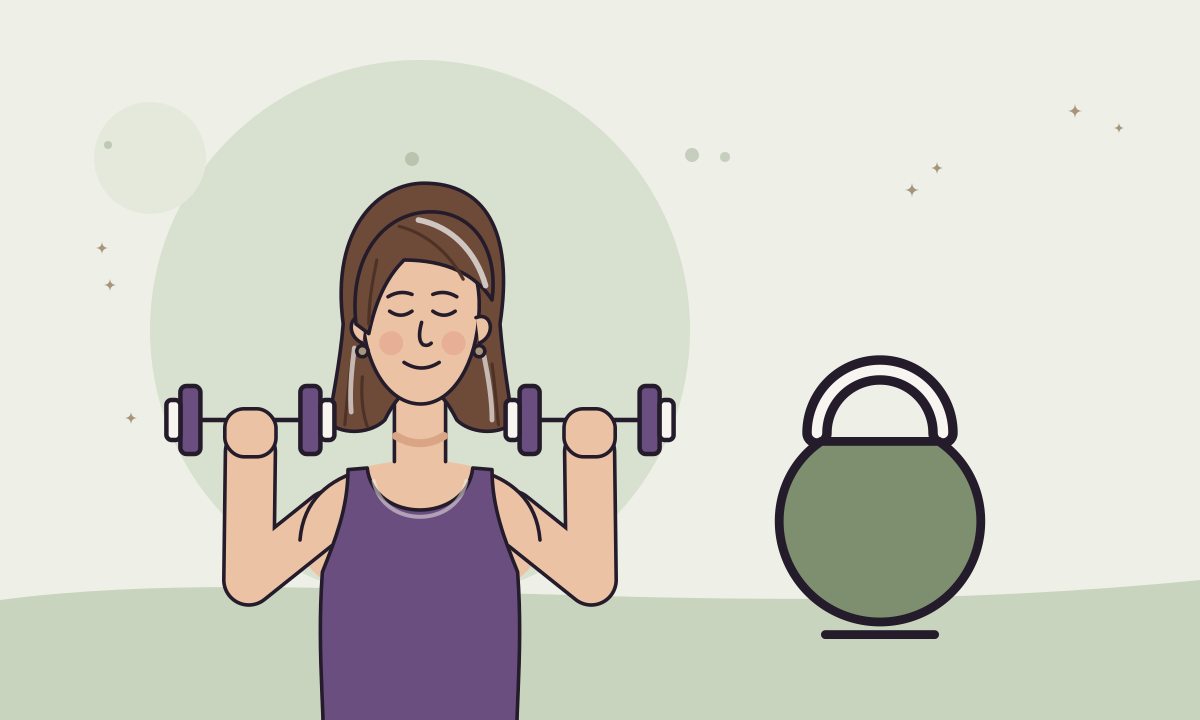
You don't need to become a bodybuilder. Here's what actually matters.
Lift two to three times a week. Consistency beats intensity. Two or three full-body sessions a week, with a rest day in between, is a great target.
Focus on the moves that matter for real life. These are the movements that keep you independent:
-
Squats (or sit-to-stands from a chair): for getting up off the couch, the toilet and the floor
-
Deadlifts (or picking a weight up off the floor): for safely lifting groceries, laundry and grandkids
-
Rows and pulldowns: for posture and a strong upper back
-
Overhead presses: for putting things on high shelves
-
Step-ups or lunges: for stairs and catching yourself when you trip
-
Carries: walk while holding a weight in each hand, just like carrying groceries
Make it challenging. This is the part most women miss. Light weights for lots of reps are better than nothing, but bones and muscles respond best to a real challenge. Aim for a weight where the last two or three reps of each set feel hard, while your form stays good. Then slowly go heavier over time.
Add balance work. Stand on one foot while you brush your teeth, try heel-to-toe walking down the hallway, or take a yoga, tai chi or Pilates class once a week.
Practice getting up off the floor. Seriously! Once a day, sit down on the floor and stand back up. Use your hands or a sturdy chair if you need to, and work toward using less support over time. It's a skill, and practicing it now keeps it.
Start where you are. If you're brand new, start with body weight or light dumbbells and machines. A trainer, a group strength class or a good beginner program can help you learn proper form. New to the gym? Read How to Walk Into a Gym for the First Time at 55.
Fuel it with protein. Your muscles need building blocks. Most women over 50 do better with more protein than they're used to, roughly 25 to 30 grams at each meal.
The bottom line
Every set you do now is an investment in the woman you'll be at 80 and 90.
Lifting builds the bones that keep a fall from turning into a broken hip. It builds the muscle that lets you get up off the floor, carry your own groceries and climb your own stairs. And paired with balance work, it helps keep you from falling in the first place.
It's not too late, and you're not too old. Start where you are, keep showing up, and let your future self thank you.
Keep reading
- Why Muscle Loss Speeds Up After Menopause (and How to Stop It)
-
Why Your Muscle Slips Away After Menopause (and How Peptides Can Help)
- How to Keep Your Muscle While Losing Weight on a GLP-1
Sources
-
Bone loss in the five to seven years after menopause, Bone Health & Osteoporosis Foundation
-
Hip fracture and mortality in older women (Study of Osteoporotic Fractures), Archives of Internal Medicine, 2011
-
High-intensity resistance and impact training in postmenopausal women with low bone mass (LIFTMOR trial), Journal of Bone and Mineral Research, 2018
-
High-intensity exercise did not cause vertebral fractures and improved posture (LIFTMOR trial), Osteoporosis International, 2019
-
Ability to sit and rise from the floor as a predictor of all-cause mortality, European Journal of Preventive Cardiology, 2014
-
High-intensity strength training in people in their 90s, JAMA, 1990
-
Exercise for preventing falls in older people living in the community, Cochrane Database of Systematic Reviews, 2019
-
Creatine during resistance training in older adults (meta-analysis), Open Access Journal of Sports Medicine, 2017
-
Two-year trial of creatine and bone health in postmenopausal women, Medicine & Science in Sports & Exercise, 2023
-
Dietary protein recommendations and the prevention of sarcopenia, Current Opinion in Clinical Nutrition and Metabolic Care, 2009
This article is for educational purposes only and isn't medical advice. Talk with your doctor before starting a new exercise program or supplement, especially if you have osteoporosis, a history of fractures, heart concerns or balance issues.