Journal The Still Her Series · Part 1
Start here
Your Body Isn't Broken, It's Recalibrating
The changes feel random. They follow a pattern, and the pattern has an after.
Maybe you've had a stretch where you honestly felt betrayed by your own body. You'd done what you were supposed to do for 50 years. You ate reasonably, you walked, you took your vitamins. And suddenly it was acting like a stranger. Hot when the room was cold. Wide awake at 3 a.m. Thicker in places you'd never been thick before.
I kept thinking, Something must be broken.
What finally helped me was picturing the thermostat in my house. When we replaced our old furnace, the new one ran a little differently for weeks. It overshot, kicked on and off, and made us sweat one night and shiver the next. Nothing was broken. It was learning new settings.
That's the best way I know to describe menopause. Your body isn't failing. It's recalibrating, and for a while, recalibrating is messy.
Meet the hormones (the short version)
Most of us never really understand our hormones until we're in the middle of losing them. So here's the cheat sheet we all should have been handed.
- Estrogen is the big one. It's best known for running your cycle, but it also helps manage your body temperature, sleep, mood, memory, skin, bones, muscles, and where your body stores fat. That's why losing it touches so many parts of your life.
- Progesterone is estrogen's calming partner. It helps balance estrogen's effects and supports sleep. It's often the first to decline, sometimes years before your periods stop.
- Testosterone isn't just a "man's hormone." Women make it too, and it plays a role in desire, energy, and muscle. Ours declines gradually with age rather than dropping off a cliff at menopause.
- FSH (follicle-stimulating hormone) is the messenger from your brain telling your ovaries to get to work. As your ovaries slow down, your brain "shouts" louder, and FSH rises. That's one reason a single blood test can be confusing during this time.
The key thing to know: these hormones didn't just run your reproductive system. They were part of the operating system for your whole body. When they shift, everything that relied on them has to adjust.
The bumpy middle: why perimenopause can feel worse than "after"
This next part surprised me more than anything else I read.
Most of us assume menopause is a slow, steady decline in estrogen, like a dimmer switch turning down. It isn't, at least not at first. Endocrinologist Dr. Jerilynn Prior at the University of British Columbia calls perimenopause "estrogen's storm season." Her research found that during perimenopause, estrogen levels can swing wildly to double or triple the usual menstrual cycle's peak, then back down. Meanwhile, progesterone tends to fall.
So it's not a dimmer switch. It's more like someone flicking the lights on and off. High, low, high, crash. Your body never gets a chance to settle.
That explains so much:
- Why you can have night sweats while your periods are still regular
- Why your mood can turn on a dime
- Why your breasts are sore one month and your periods are heavier than ever the next
- Why you feel fine for weeks and then terrible for no clear reason
And here's the hopeful part. Perimenopause can last anywhere from a couple of years to more than 10, but it ends. Once the storm passes and hormones settle at their new, lower level, many women find things feel steadier. The swings stop. Your body finally has fixed settings to adjust to.
Recalibrating, system by system
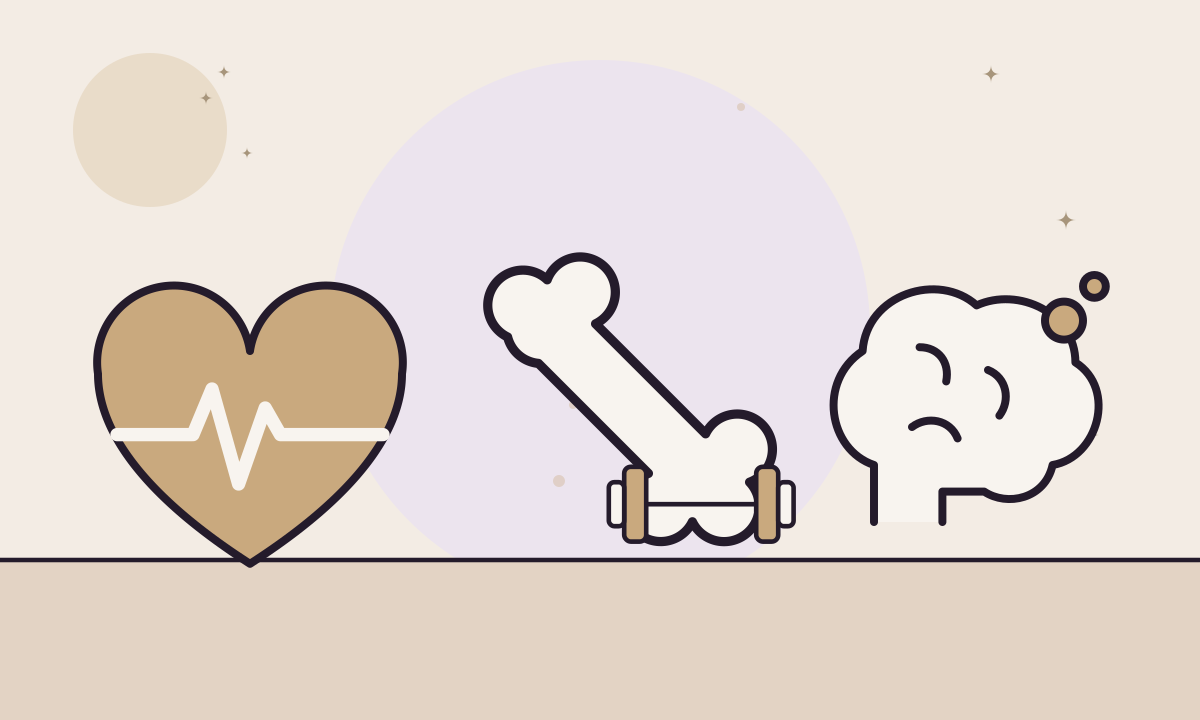
Once I understood that estrogen was woven through my whole body, my symptoms stopped looking random. Each one was a different system learning to run on new settings.
Your thermostat: hot flashes and night sweats
This one is almost literally a thermostat. Your brain keeps your core temperature inside a comfortable band, where you don't need to sweat or shiver. Researcher Robert Freedman measured that band in women with and without hot flashes. In women without them, it was about 0.4°C wide. In women with hot flashes, it was essentially zero.
So the tiniest rise in your core temperature, from a warm room, a cup of coffee, or a heavy blanket, sets off the full cooling response. Flushing, sweating, racing heart. Then you're freezing. Your body isn't malfunctioning. Its comfort zone just got very narrow for a while.
Your sleep
Night sweats wake you up, of course. But progesterone and estrogen also play roles in how deeply and steadily we sleep, so even nights without sweats can feel lighter and more broken. This is one of the most common complaints of all, and it gets its own article: The 3am Wake-Up Call.
Where your body stores fat
Before menopause, estrogen tends to send fat to your hips and thighs. As estrogen falls, storage shifts toward the belly and upper body. That's why so many of us gain a middle we never had, even when the scale barely moves. It's not a willpower problem. It's a new storage setting. (More in The Easiest Way to Lose Weight After Menopause.)
Muscle and bone
Estrogen helps protect both. When it drops, muscle becomes harder to build and keep, and bone loss speeds up in the years around your last period. This is the one system where "recalibrating" isn't enough on its own. Your body needs you to send it a new signal, which mostly means lifting things and eating enough protein. (More in Why Muscle Loss Speeds Up After Menopause.)
Your skin
Estrogen helps your skin make collagen. Studies have found that as much as 30% of skin collagen is lost in the first five years after menopause, then about 2% a year after that. That's the "crepey" feeling so many of us notice almost overnight. (More in Why Your Skin Changed Overnight.)
Your brain
I wrote about this in the first article, and it's still my favorite example. Brain scans show real changes during the transition. But in many women, the brain then adapts and finds a new normal after menopause. If there were ever a perfect picture of recalibrating, that's it.
What "after" looks like
I want to be honest with you here, because I think you deserve the real picture, not a pep talk.
Some things usually settle. The wild swings of perimenopause end. For many women, hot flashes fade over time. In the big SWAN study, frequent hot flashes continued for a median of about 4.5 years after the final period, and then they eased. Moods often steady once hormones stop bouncing around. Many women describe the years after menopause as calmer, clearer, and more their own.
Some things need ongoing care. Bone, muscle, heart health, and skin don't bounce back on their own once estrogen stays low. They don't need a miracle, either. They need you to give them new inputs: strength training, protein, sleep, and conversations with your doctor about options like hormone therapy. That's what most of this series is about.
So recalibrating doesn't mean everything goes back to how it was at 35. It means your body finds a new normal, and you get to help decide what that normal looks like.
Working with your new settings
You can't stop the recalibration, but you can make it a lot gentler. A few things that help right away:
- Work with your thermostat. Since tiny rises in core temperature set off hot flashes, keep your bedroom cool, dress in layers, and notice your triggers. For a lot of us, those are hot drinks, alcohol, spicy food, and stress.
- Track your symptoms for a month. Write down sleep, hot flashes, mood, and your cycle if you still have one. Patterns show up fast, and a month of notes is gold at a doctor's visit.
- Give muscle and bone a new signal. Even two short strength sessions a week tell your body to hold on to what you have.
- Be patient with the bumpy middle. If you're still in perimenopause, some of what you're feeling is the storm, not the destination.
- Talk to someone who knows menopause. Your body's new settings are worth a real conversation about your options, including hormone therapy if it's right for you.
What's next in this series
Next up: Three Seasons: Before, During, After. It's a simple map of the whole journey, so you can see where you are and what's ahead, whether you're just starting to notice changes or you're years past your last period.
Not sure which season you're in? Take the 60-second quiz, What's your menopause season?, and I'll point you to the articles that fit you best.
Sources
- Prior JC. Paradoxes of Perimenopause and Perimenopause: The Ovary's Frustrating Grand Finale. Centre for Menstrual Cycle and Ovulation Research, University of British Columbia.
- Freedman RR. Menopausal Hot Flashes: Mechanisms, Endocrinology, Treatment. Journal of Steroid Biochemistry and Molecular Biology, 2014.
- Avis NE, et al. Duration of Menopausal Vasomotor Symptoms Over the Menopause Transition. JAMA Internal Medicine, 2015 (SWAN study).
- Calleja-Agius J, Brincat M. Skin Ageing. Menopause International, 2007.
- Menopause Face: How Falling Estrogen Changes Skin, Fat and Bone. Acibadem International (fat distribution).
- NewYork-Presbyterian: The Brain: A New Normal After Menopause (Mosconi et al., Scientific Reports, 2021).
This article is for education only and isn't medical advice. Talk with your healthcare provider about your symptoms and before starting any new treatment, supplement, or exercise program.