Skin, Hair & Collagen
Retinoids After 50: How to Start Without the Irritation
Retinoids are some of the best-studied skincare there is. Here's how to start without the redness.
It's a common story. You buy the strongest retinol on the shelf, slather it on every night, and add your usual exfoliating toner for good measure. By day four your cheeks are red, tight and peeling like a sunburn. By day five, the bottle is in the back of the bathroom drawer, where it stays for years.
What most of us don't know: retinoids are some of the best-studied skincare ingredients we have, and they really can help skin after menopause. But skin after 50 is thinner and drier, and it needs a slower, gentler start.
So if you've tried a retinoid and given up, or you've been too nervous to try, this one's for you. Here's how to start without the irritation.
What retinoids do, and why they matter after menopause
Retinoids are a family of ingredients made from vitamin A. On your skin, they speed up how quickly old skin cells are replaced and signal your skin to make more collagen, the protein that keeps it firm.
That's a big deal after menopause. Women can lose up to 30% of their skin collagen in the first five years after menopause, which is why skin can suddenly look thinner, crepier and more lined (our article Why Your Skin Changed Overnight: The Collagen Drop After Menopause goes deeper).
And it's not just for sun damage. In a University of Michigan study of 36 people with an average age of 87, researchers applied a 0.4% retinol lotion to one arm and a plain lotion to the other, up to three times a week for 24 weeks. The retinol arm had significantly fewer fine wrinkles and less roughness, and skin samples showed more collagen and more of the compounds that help skin hold water. In other words, it's never too late to start.
With regular use, retinoids can help with:
- Fine lines and wrinkles
- Rough, dull or uneven texture
- Brown spots and uneven tone
- Thin, fragile skin
Meet the retinoid family
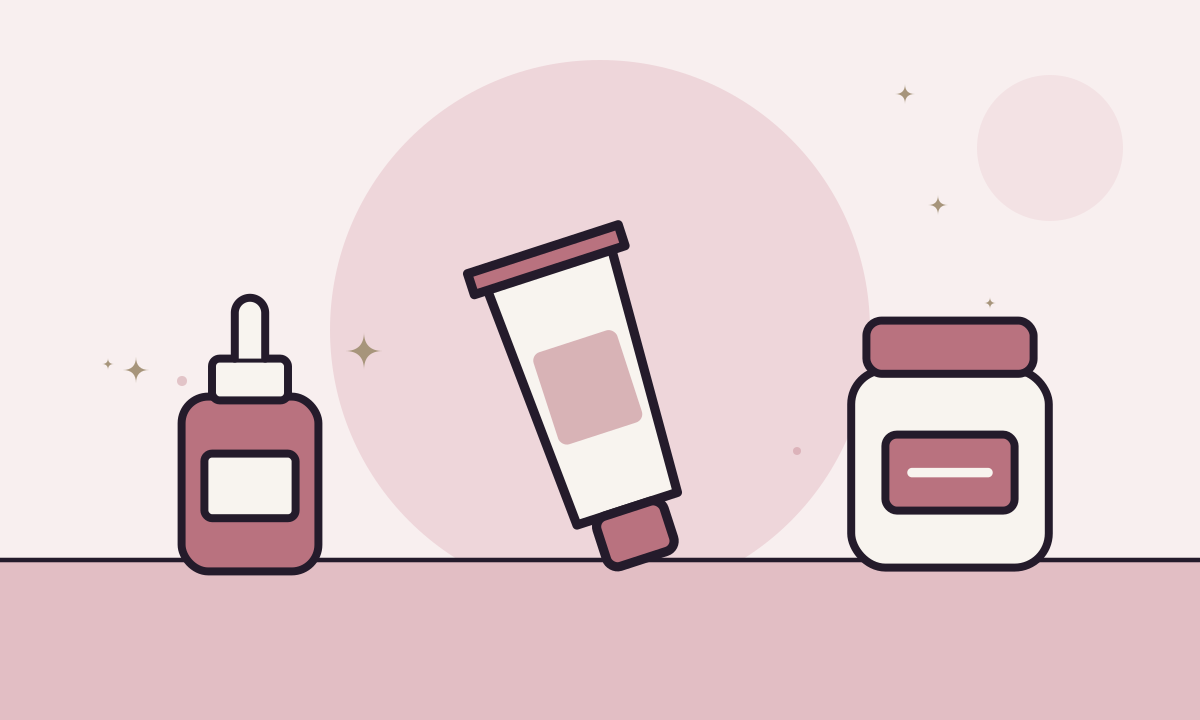
"Retinoid" is the umbrella name. Here are the ones you'll see, from gentlest to strongest:
- Retinyl palmitate and other retinyl esters. The mildest. Very gentle, but also the weakest. Often found in moisturizers.
- Retinol. The most common over-the-counter option. Your skin converts it into the active form, so it's gentler and works more slowly. A great place to start.
- Retinal (retinaldehyde). One step closer to the active form, so it tends to work faster than retinol and is still fairly gentle. Available over the counter.
- Adapalene. Originally an acne treatment, now sold over the counter as a 0.1% gel. It's well tolerated, but it was mainly designed and studied for acne, not wrinkles.
- Tretinoin. Prescription-only, and the most studied retinoid for wrinkles and sun damage. Powerful, but also the most likely to irritate.
Which should you start with? If you've never used a retinoid, or your skin is dry or sensitive, start with a low-strength retinol or retinal. If that goes well after a few months and you want more, ask your doctor or a dermatologist about tretinoin.
Why mature skin gets irritated
Retinoids irritate almost everyone a little at first. Dermatologists call this early phase "retinization," and it usually shows up in the first two weeks: redness, dryness, flaking, tightness or stinging. It typically fades as your skin adjusts over a few weeks.
After menopause, though, a few things make that adjustment harder:
- Thinner skin. Lower estrogen means fewer layers between the retinoid and the nerves that sting.
- A weaker moisture barrier. Our skin makes less oil and holds less water, so it dries out faster.
- Slower healing. Irritation takes longer to calm down.
None of this means you can't use retinoids. It just means you need to go slower than the bottle tells you to.
The slow-start plan
Here's the plan to follow from the start. The rule is simple: start low, go slow, and stay consistent. A gentle retinoid you use for years beats a strong one you quit in a week.
And you can go even slower than this. If you want to play it extra safe, or your skin tends to be sensitive, start with just once a week. Stay at each step as long as you like, even a month or more, and only move up when your skin has had no issues. There's no prize for getting to nightly fast. Slow and steady still gets you there.
Before you start
- Pick a low-strength retinol or retinal. Look for something labeled for beginners or sensitive skin.
- Simplify everything else. For now, use a gentle cleanser, a plain moisturizer and sunscreen. Put exfoliating acids, scrubs and other strong products on pause.
- Use only a pea-sized amount for your whole face. More is not better here.
Weeks 1–2: twice a week
Pick two nights that aren't back to back, like Monday and Thursday. Wash your face, pat it completely dry, wait about 10 minutes, and apply your pea-sized amount. Dot it on your forehead, cheeks and chin, then spread it gently. Keep it away from the corners of your eyes, nose and mouth, where skin is thinnest. Follow with moisturizer.
Weeks 3–4: three nights a week
If your skin feels okay, add a third night, still with a night off in between.
Weeks 5–8: every other night
Keep going if your skin is calm. If you get red or flaky, drop back to the last schedule that felt good, and stay there a little longer.
After 2–3 months: nightly, if your skin is happy
Many women over 50 are happiest staying at every other night for good, and that's completely fine. Consistency matters much more than frequency.
Every morning, no matter what: sunscreen. Retinoids can make your skin more sensitive to the sun, and the sun breaks down the very collagen you're trying to build. Use a broad-spectrum SPF 30 or higher on your face, neck and chest.
What to expect: smoother texture in about a month, and softer fine lines and more even tone in about 3 to 6 months. The results keep building the longer you stick with it.
If your skin gets irritated
A little dryness or flaking in the first few weeks is normal. Here's how to calm it down without quitting:
- Try the "sandwich." Put on a thin layer of moisturizer, then your retinoid, then more moisturizer on top. The bottom layer acts as a buffer. Dermatologists often recommend this for dry, mature or sensitive skin. It may slightly slow results, but it's far better than giving up.
- Try "short contact." Leave the retinoid on for 30 to 60 minutes, then rinse it off and moisturize. Slowly increase the time as your skin adjusts.
- Take a break. If your skin is raw, red or burning, stop for a few nights, use only a gentle moisturizer until it heals, then restart at a lower frequency.
- Protect the delicate spots. A thin layer of a plain ointment like petroleum jelly around your eyes, nostrils and mouth keeps the retinoid from creeping into those areas.
- Don't apply it to damp skin. Wet skin absorbs more of the retinoid, which makes stinging more likely.
What not to mix, at least at first:
- Exfoliating acids (glycolic, lactic, salicylic) and scrubs
- Benzoyl peroxide, which can inactivate some retinoids
- Waxing on areas where you use a retinoid, since it can pull off skin
Once your skin is used to the retinoid, you can usually bring some of these back on different nights. Vitamin C serum in the morning pairs well with a retinoid at night.
When to call a doctor: if you have swelling, blistering, oozing, or a rash that spreads past where you applied it, stop and check with a doctor or dermatologist. That may be a reaction, not normal adjustment. And if you have rosacea, eczema or very sensitive skin, ask a dermatologist before you start.
If your skin just can't handle it: bakuchiol
Some skin simply doesn't tolerate retinoids, even with the slow plan. If that's you, look into bakuchiol, a plant-based ingredient from the seeds of the babchi plant. It isn't a retinoid, but it seems to work in some similar ways.
In a 12-week randomized study of 44 people, one group used a 0.5% bakuchiol cream twice a day and the other used a 0.5% retinol cream once a day. Both groups saw significantly fewer wrinkles and less discoloration, with no real difference between them. The retinol group reported more scaling and stinging. It was a small study, so we need bigger ones, but it's a promising option for sensitive skin.
Other gentle options to pair with or try instead of a retinoid: GHK-Cu copper peptide serums (our GHK-Cu articles cover these: Injectable GHK-Cu: What Women Are Saying About the 'Beauty Peptide', Injectable GHK-Cu for Hair, and the cream research in Why Your Skin Changed Overnight), and a good moisturizer with ceramides and hyaluronic acid.
The bottom line
Retinoids are one of the best-studied ways to help skin after menopause, and even skin in its 80s responds to them. The secret for us is starting slower than you think you need to.
- Start with a gentle retinol or retinal, a pea-sized amount, twice a week.
- Build up slowly over two to three months.
- Buffer with moisturizer if you get dry or flaky.
- Wear sunscreen every single morning.
- Try bakuchiol if your skin just won't cooperate.
That retinol in the back of the bathroom drawer? Try again, twice a week with the sandwich method. Give it a few months, and it may become the one product you'd never give up.
Not sure where you are in all of this? Take our quiz: What's your menopause season? It takes about a minute and points you to the articles that fit where you are right now.
Sources
- Kafi R, et al. Improvement of naturally aged skin with vitamin A (retinol). Archives of Dermatology, 2007. Link
- Dhaliwal S, et al. Prospective, randomized, double-blind assessment of topical bakuchiol and retinol for facial photoageing. British Journal of Dermatology, 2019. Link
- Siddiqui Z, et al. Comparing tretinoin to other topical therapies in the treatment of skin photoaging: a systematic review. American Journal of Clinical Dermatology, 2024. Link
- Calleja-Agius J, Brincat M, et al. Skin ageing. Menopause International, 2007. Link
Some links in this article are affiliate links. If you buy through them, we may earn a small commission at no extra cost to you. We only recommend products we'd use ourselves.
This article is for education only and isn't medical advice. Talk with a doctor or dermatologist before starting a retinoid, especially if you have rosacea, eczema or very sensitive skin, or if you use prescription skin treatments.